
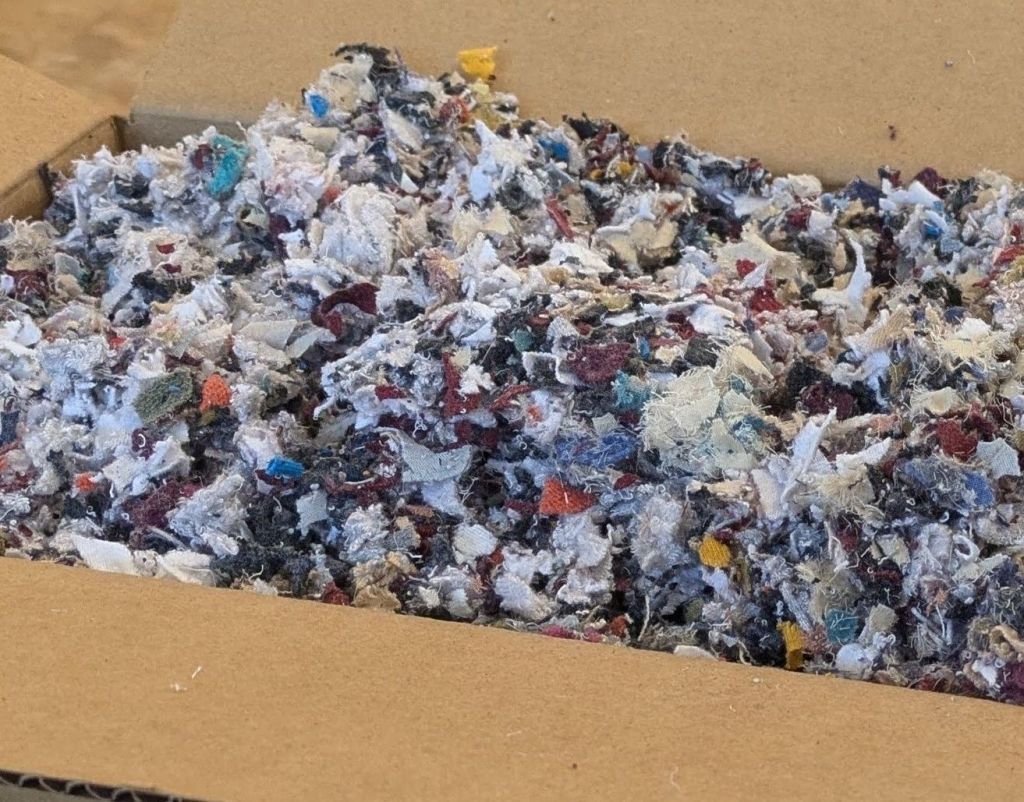
5 lb boxes, $7.50 — 1 lb bags, $2
1 lb samples available on request
Delivery available in Hillsborough/Durham/Chapel Hill.
Email MakingSomethingWithEverything@gmail.com
(payment options: venmo, cashapp, credit card)
Why are you doing this?
To keep textile waste in local circulation.
I worked in textile collection (like those bins in parking lots that say “donate clothes and shoes here” and got sort of fixated on textile waste (there’s A LOT a lot). I started hosting clothing swaps all around town with Circular Triangle, and have ended up with a lot of clothing not in good enough shape to donate. I got the shredder as a way to manage some of that waste.
Learn more about why I bought this shredder here
What type of fabrics do you shred?
I’ve started out with mixed clothing (mostly cotton/polyester).
Most clothing are cotton/polyester blends of one sort or another, and that shred up well.
Straight cotton, especially fluffy things like towels, come out VERY fluffy, and create a big feathery dust cloud when shredding.
100% polyester comes up in nice shreds, as you would expect from a plastic.
More questions? I would be so happy to talk to you. Email makingsomethingwitheverything@gmail.com
Info about the machine – where’s it from? How’s it work?
This plucky little machine shipped all the way from China, via Alibaba.com. Look for ‘textile shredder’, ‘fabric crusher’, ‘clothing shredder’, etc. A significant portion of the cost was in shipping.
I have not seen shredders of this size available in the US, though there are much larger (warehouse-sized) shredders available here.
If you know of somebody selling small shredders in the US, I would love to hear about it!
How long did it take to arrive? 2 months.
If it needs maintenance/servicing, how easy will it be to get that?
It’s pretty simple, a big motor, 4 big heavy blades, and a plate on the bottom with holes that sets how big the shred is when it comes out. It came with replacement blades and different sized plates. The plates seem easy to switch in and out and it seems like it’ll be easy to oil, etc. But I don’t know how easy it’ll be to fix if it breaks – I’m lucky to have an electrician friend who I’ve relied on.
Is it very noisy to use? Yes! Wear ear protection. But it’s honestly not as loud as I thought it’d be, I have it in a shed around back of my house and it doesn’t bother the neighbors.
How is it powered? It’s electric. The manufacturer can make it either 120v or 220v (it’s important to mention that you’re from the US so they set it up right.) You will need an electrician. I am extremely grateful to my electrical engineer friend who wired it directly to a new circuit in the breaker box that I have in the shed. I also had him look at the specifications before finalizing my order, to ensure it was something he could wire up. It’s like adding a washer/dryer or HVAC. It has not spiked my energy bills noticeably, but I’m going to try and find out how much cost in involved in the energy as we go.
How much shredded fabric can you make in an hour?
About 20 lbs per hour, shredding fabric prepared for the machine.
The fabric is hand fed.
How are fabrics prepared?
There should be absolutely no zippers, buttons, etc., or you risk stalling out your motor or chipping your blades. If they do make it through the shredder, you’ve contaminated the final product with hard sharp bits of shredded buttons or whatever.
Fabric does need to be small enough to run smoothly through the machine. Small shirts are OK to go through whole, but large shirts, jackets, sheets, etc need to be cut up.
The weight of the fabric matters as well – heavy fabrics need to be smaller.
Shoving too much fabric in at once will clog the chute, or can overwhelm the blades and stall it out.
Is this a sustainable solution to fast fashion?
No. Just like with plastics, we can’t recycle our way out of overconsumption. Eventually this shred will still end up in the landfill, because it can’t be turned back into clothing. It won’t replace manufacturing with raw materials.
The solution to the pile of textile waste we’re constantly, globally generating is to reduce the overabundance of materials manufactured. Buying fewer newly made clothes is one way to have an impact. Requiring producers take responsibility for the reusability of what they produce is another.
That said, the fast fashion spigot won’t be turned off in a day. Much of our old clothing ends up exported and polluting the global south. While we figure out how to feed our appetite for trends without generating extraordinary piles of trash, shredding is a good option out of many bad choices. It delays the inevitable landfill, keeps material in local circulation, and can replace other plastic-intensive stuffing options like polyfil.
More questions? I would be so happy to talk to you. Email makingsomethingwitheverything@gmail.com
 Making Some